AP Physics 1
Class Projects - Windows Applications ©
Welcome to the AP Physics 1 Class Projects site. This site features a variety of valuable class projects designed for physics teachers and students. Most of these projects are based on actual AP Physics problems from past official exams. We have developed these problems into engaging learning activities that offer significant academic benefits. For example, the Bouncing Ball project is an excellent newtonian mechanics activity that requires approximately four hours of focused work and the application of concepts in projectile motion, conservation of momentum, and conservation of energy.
Teachers are advised to provide a different set of values for students to utilize in each project. Each project includes a detailed tutorial that outlines the required tasks. Additionally, there is a Windows application included with each project that quickly generates answer keys for all projects assigned to an entire class, allowing teachers to grade each project in approximately one minute. These educational products are made affordable for teachers; for just $12.00, you can purchase a class project from Teachers Pay Teachers that will offer your students a memorable learning experience. You have the option to select the output format for the answer keys that best suits your needs. In some projects, the answer keys are displayed on the computer screen, while in others, the output is a text file that can be edited and printed.
The projects available are the following:
The Bouncing Ball
Rotation in a Vertical Plane
Rotation in a Horizontal Plane
Projectile Motion
Vectors
The Inclined Plane and the Spring
The Vertical Spring
The Pendulum
The Block on the Sphere
Gravitation
Links to switch to other parts of our web site are located at the bottom of this page.
The
Bouncing Ball Class Project
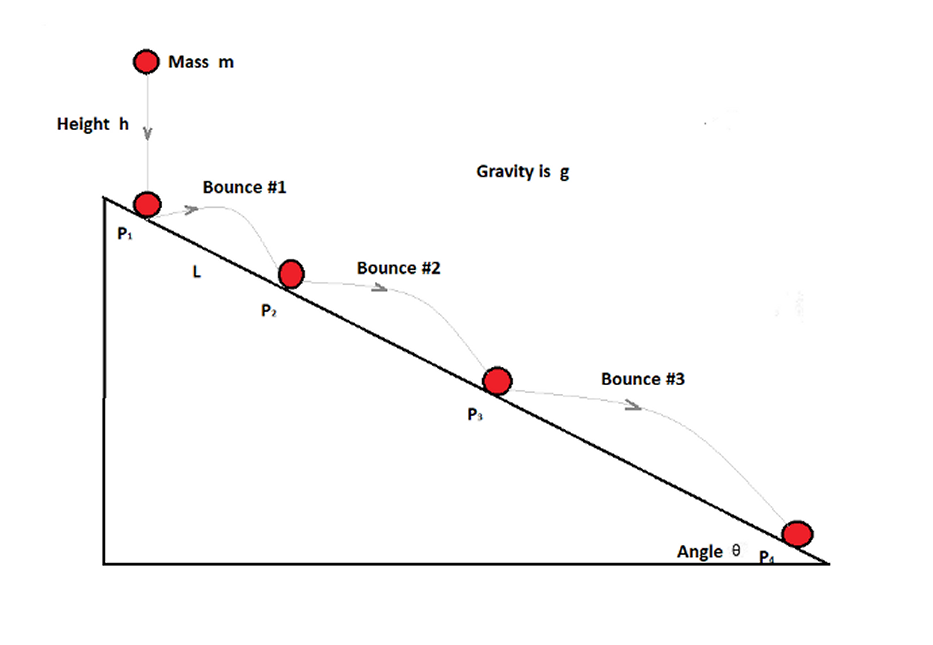
A ball is released from a point above an inclined plane. The following information is known:
the mass m of the ball
the height h above the inclined plane where the ball is released.
The angle of inclination θ the plane makes with the horizontal.
The value of gravity g
The ball is permitted to bounce five or more times along the inclined plane. For each bounce, students are required to calculate several values. The first bounce occurs from point P1 to point P2, the second bounce from point P2 to point P3, the third bounce from P3 to point P4, and so forth. All bounces are perfectly elastic, meaning there is no loss of kinetic energy during each collision with the plane. Additionally, momentum is consistently conserved. Students must determine ten values for each bounce. For example, during the second bounce between points P2 and P3, students will calculate the following quantities (note that in this bounce, the first point is P2 and the second point is P3):
The velocity of the ball at the first point - Variable VEL(P2)
The velocity of the ball at the second point - Variable VEL(P3)
The time the ball takes to travel between the two points - T
The distance traveled along the plane between the two points - Variable L
The horizontal velocity immediately after beginning the bounce - Variable Vx
The vertical velocity immediately after beginning the bounce - Variable Vy
The angle the ball makes with the vertical right before it bounces from the first point - Variable Beta
The angle the ball makes with the inclined plane right before or right after it bounces from the first point -
Variable INC
The angle the ball makes with the horizontal immediately after it bounces from the first point - Variable
ALPHA
Kinetic energy of the ball at the first point - Variable KE
The Bouncing Ball Class Project 1: The data for an entire class is entered in a text file in a few minutes, and
the answer keys, one by one, are printed on the screen. A Vectors tutorial is included.
Link to The Bouncing Ball Class Project 1 in TpT
Cost: $12.00
The Bouncing Ball Class Project 2: The data for an entire class is entered in a text file in a few minutes. All
the answer keys are sent to a text file, which can be analyzed on the screen or printed on paper. A Vectors
tutorial is included.
Link to The Bouncing Ball Class Project 2 in TpT
Cost: $12.00
The Bouncing Ball Class Project 3: The data for one student is entered on the screen in a few seconds, and the
answer key is printed on the screen right away. It includes a Vectors tutorial.
Link to The Bouncing Ball Class Project 3 in TpT
Cost: $12.00
The Bouncing Ball Class Project 4: The data for one student is entered on the screen in a few seconds, and the
answer key is sent to a text file. The content of the text file can be seen on the screen or sent to a printer.
It includes a Vectors tutorial.
Link to The Bouncing Ball Class Project 4 in TpT
Cost: $12.00
Rotation in a
Vertical Plane Class Project
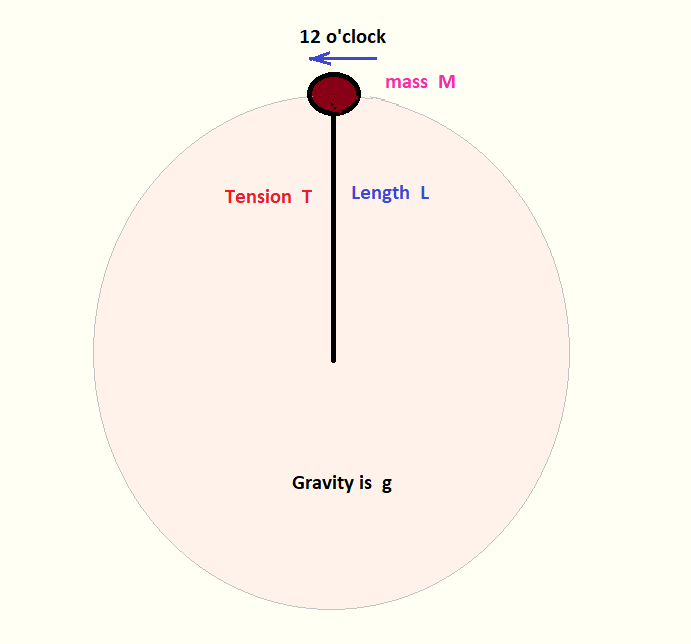
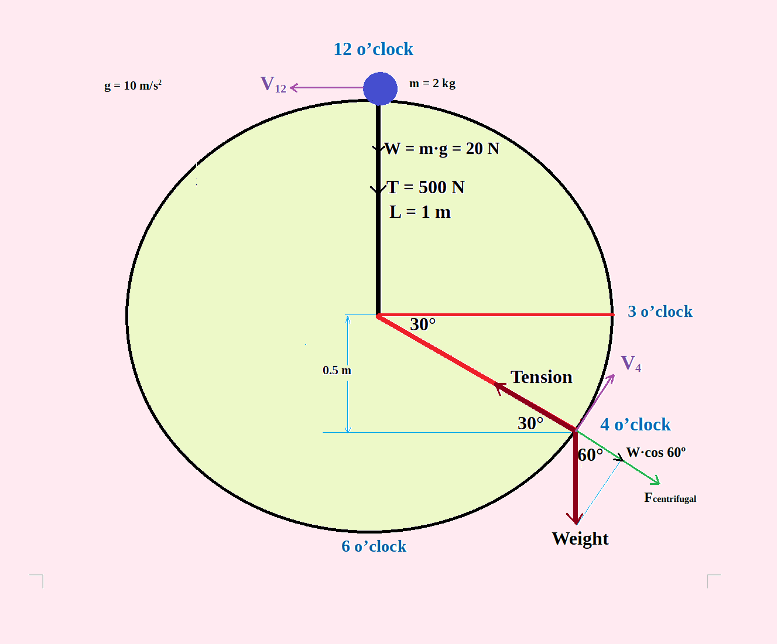
A ball of mass M kg is attached at the end of a string, and it is rotating counterclockwise in a vertical plane.
The following information is known:
the mass M of the rotating ball
the tension T at the 12 o'clock position.
The length L of the string.
The value of gravity g
The purpose of this project is that for each hour of the clock, the students will find the following values:
Angular Displacement (measured from 12 o'clock counterclockwise)
Linear Displacement (measured from 12 o'clock counterclockwise)
Angular and Linear Velocity
Angular and Linear Acceleration
Tension in the string
Potential Energy (PE = 0 J 6 o'clock)
Kinetic Energy
Total Energy
Centripetal Force and Acceleration
Net Force and Direction of the Net Force
Angular Momentum and Moment of Inertia
Rotation in a Vertical Plane Project 1: The data for one student is entered on the screen in a few seconds, and
the answer key is printed on the screen right away. The answer key includes the solution for every hour of the
clock. This project incorporates a Rotation in a Vertical Plane tutorial.
Link to The Rotation in a Vertical Plane Class Project 1 in TpT
Cost: $12.00
Rotation in a Vertical Plane Project 2: The data for one student is entered on the screen in a few seconds, and
the answer key is printed on the screen and also in a text file. The answer key includes the solution for one
hour of the clock. This project includes a Rotation in a Vertical Plane tutorial.
Link to The Rotation in a Vertical Plane Class Project 2 in TpT
Cost: $12.00
Rotation in a Vertical Plane Project 3: The data for one student is entered on the screen in a few seconds, and
the answer key is printed in a text file. The answer key includes the solution for every hour of the clock. This
project includes a Rotation in a Vertical Plane tutorial.
Link to The Rotation in a Vertical Plane Class Project 3 in TpT
Cost: $12.00
Rotation in a Vertical Plane Project 4: The data for one class is entered in a text file in a few minutes, and
the answer keys are printed in individual text files. The answer keys include the solutions for every hour of
the clock. This project includes a Rotation in a Vertical Plane tutorial.
Link to The Rotation in a Vertical Plane Class Project 4 in TpT
Cost: $12.00
Rotation in a Horizontal Plane Class Project

A block attached to a string is rotating on a horizontal surface. There is friction between the block and the
surface. Eventually the block stops. The following information is known:
The mass of the block
Gravity
Length of the string
Initial angular velocity in rpm
Angular displacement (number of revolution to stop)
The following values will be determined:
Angular acceleration
Time to stop
Average force of friction
Total heat produced
Initial tension in the string
For every revolution the block travels until it stops, the computer also will calculate:
Linear Displacement
Angular Velocity
Linear Velocity
Angular Acceleration
Linear Acceleration
Tension in the String
Force of Friction
Heat Produced
Time Passed
Rotation in a Horizontal Plane Project: The data for one student is entered on the screen in a few seconds, and
the answer key is printed on the screen right away.
Link to The Rotation in a Horizontal Plane Project in TpT
Cost: $12.00
Projectile
Motion Class Project

A projectile is ejected at an angle above the horizontal and it will stay in flight for about 100 s. The
following information is known:
the Initial Velocity Vo the projectile is thrown.
The angle of inclination θ above the ground.
The value of gravity g
The computer will calculate:
Time to reach the peak
Total Time the projectile is in flight
Total Range
Maximum Height
In addition, for each 5-second interval the computer will find:
Horizontal Velocity
Vertical Velocity
Speed
Range
Height
Angle of inclination
Linear acceleration
Besides the mathematical solution, the students also will do the graph Height vs. Time.
Projectile Motion Class Project 1: The data for one student is entered on the screen in a few seconds, and the
answer key is printed on the screen right away. It includes a Projectile Motion tutorial.
Link to The Projectile Motion Class Project 1 in TpT
Cost: $12.00
Projectile Motion Class Project 2: The data for one student is entered on the screen in a few seconds, and the
answer key is printed in a text file right away. It includes a Projectile Motion tutorial.
Link to The Projectile Motion Class Project 2 in TpT
Cost: $12.00
Projectile Motion Class Project 3: The data for one class is entered in a text file in a few minutes. The data
entered includes an ID number for every student. The computer will use the ID numbers to generate different data
at random for every student. The answer keys are printed in a text file. This project includes a Projectile
Motion tutorial.
Link to The Projectile Motion Class Project 3 in TpT
Cost: $12.00
Vectors
Class Project
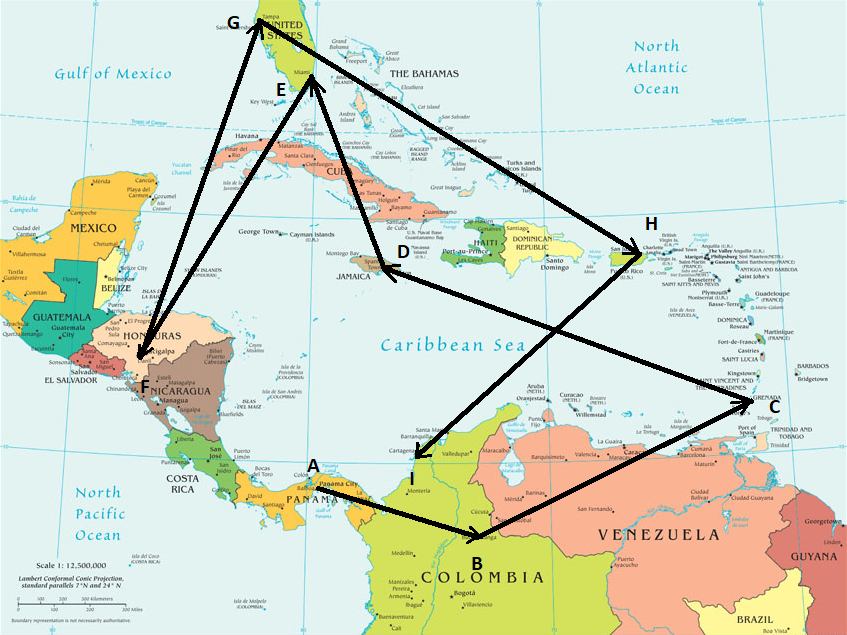
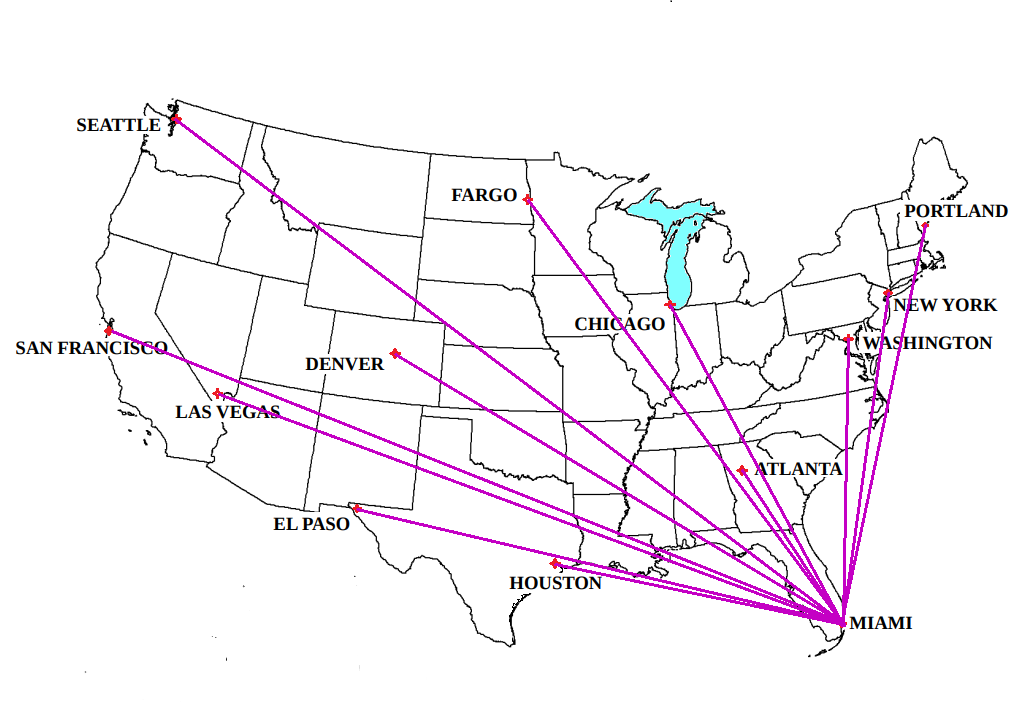
The Vectors Class Project involves a hypothetical journey by airplane to various cities. Initially, the airplane departs from city A and travels to city B, then from city B to city C, and subsequently from city C to city D, continuing in this manner. For each pair of cities, such as between cities B and C, both the distance and the direction of the second city relative to the first are provided. The primary objectives for the students are to calculate: (a) the distance from every city back to city A, and (b) the direction of each city in relation to city A. Essentially, students will engage in the addition of 10 or more vectors. After completing the mathematical calculations, students will also address their vector problems graphically. Comprehensive guidance is provided in a well-structured tutorial. In the table that students must complete for the mathematical solution, the columns are organized as follows:
Cities (from)
Cities (to)The velocity of the ball at the second point - Variable VEL(P3)
Distance
Direction
Horizontal Projection
Vertical Projection
Summation of Horizontal Projections
Summation of Horizontal Projections
Resultant (Distance)
Resultant (Direction)
Vectors Class Project 1: The data (distance and direction) for one student is entered on the screen in a few
seconds for each vector, and each time the Resultant is printed on the screen. The limit is 25 vectors. The
project includes a well designed tutorial.
Link to Vectors Class Project 1 in TpT
Cost: $12.00
Vectors Class Project 2: The data for one class is entered in a text file in a few minutes. The data entered
includes an ID number for every student. The computer will use the ID numbers to generate different data for
every student following specific rules. The answer keys are printed on the screen one by one. This project
includes a Vectors Tutorial.
Link to Vectors Class Project 2 in TpT
Cost: $12.00
Vectors Class Project 3: The data for one student is entered on the screen in a few seconds. The data entered
includes an ID number. The computer will use the ID numbers to generate different data for the student following
specific rules. The answer key sent to a text file. This project includes a Vectors Tutorial.
Link to Vectors Class Project 3 in TpT
Cost: $12.00
Vectors Class Project 4: The data for one class is entered in a text file in a few minutes. The data entered
includes an ID number for every student. The computer will use the ID numbers to generate different data for
every student following specific rules. The answer keys are printed in a text file. This project includes a
Vectors Tutorial.
Link to Vectors Class Project 4 in TpT
Cost: $12.00
Vectors Class Project 5: The data for one class is entered in a text file in a few minutes. The data entered
include the names of the students, and the distances and directions between consecutive cities in the journey.
The answer keys are printed on the screen one by one. This project includes a Vectors Tutorial.
Link to Vectors Class Project 5 in TpT
Cost: $12.00
Vectors Class Project 6: The data for one class is entered in a text file in a few minutes. The data entered
includes the names of the students, and the distance and direction between consecutive cities in the journey.
The answer keys are printed in a text file. This project includes a Vectors Tutorial.
Link to Vectors Class Project 6 in TpT
Cost: $12.00
The Inclined Plane and the Spring Class Project
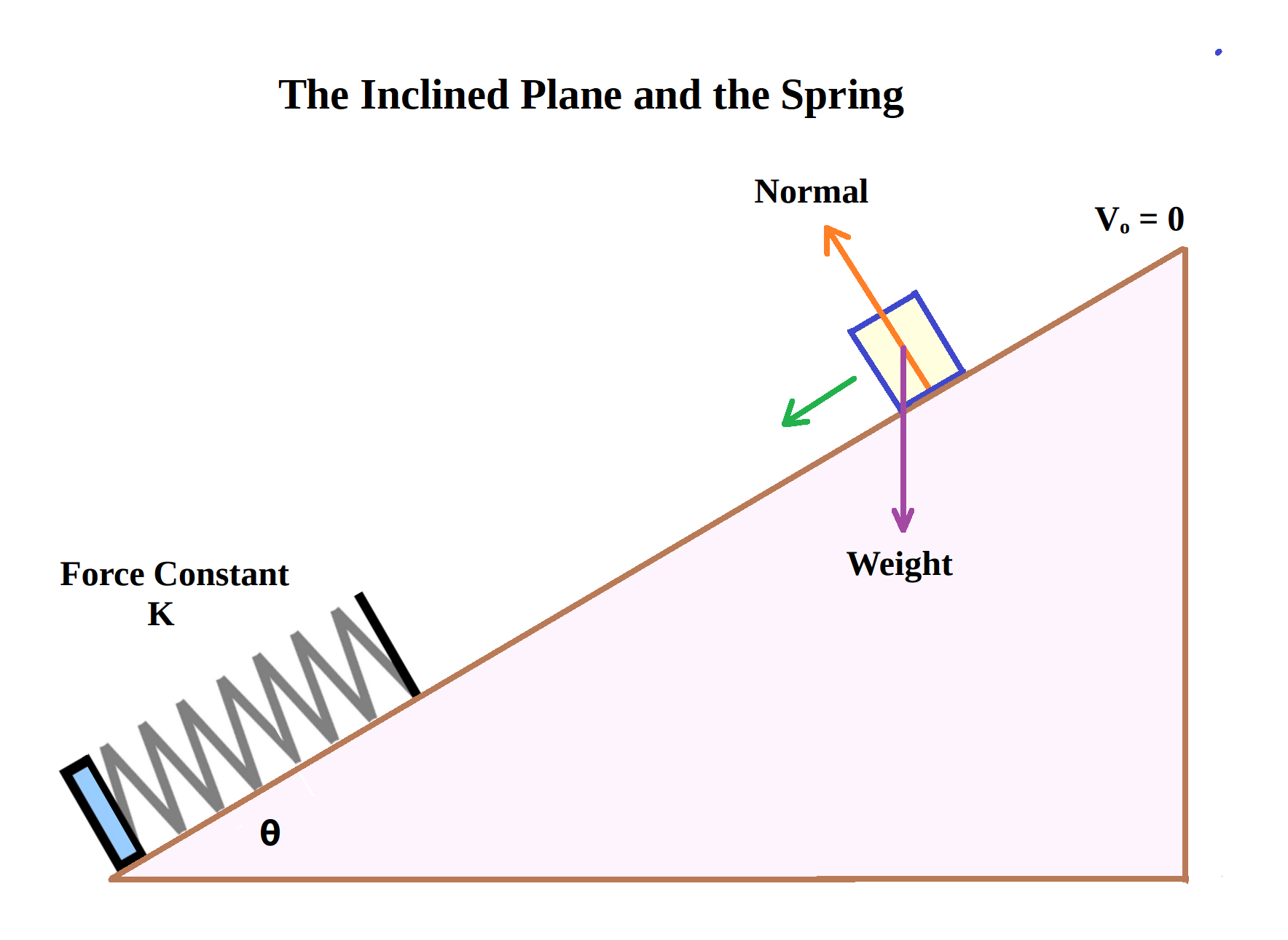
A spring is positioned at the bottom of an inclined plane. Starting from rest, a block with mass M is permitted to slide down the frictionless plane. After covering a distance d along the plane, the block begins to compress the spring. It is important to consider the question: at which point does the block achieve its maximum speed from the moment it starts sliding until it is halted by the spring?
The following values need to be entered:
the mass M of the block.
the force constant K of the spring.
The initial separation d between the block and the spring.
The angle of inclination θ of the plane.
The value of gravity g.
The computer will estimate these values:
The acceleration of the block
The velocity at the instant the block strikes the spring
The maximum length L the spring is compressed by the block
From the moment the moving block starts compressing the spring, for every centimeter the spring is compressed,
and until the block stops, the computer will calculate the following quantities:
Speed of the block
Kinetic Energy of the block
Net Force acting on the block
Acceleration of the block
Potential Energy stored in the spring
All the results will be printed on the screen.
The Inclined Plane and the Spring Project: The data for one student is entered on the screen in a few seconds,
and the answer key is printed on the screen right away. It includes a tutorial that explains step by step the
solution of this problem.
Link to The Inclined Plane and the Spring Project in TpT
Cost: $12.00
The
Vertical Spring Class Project
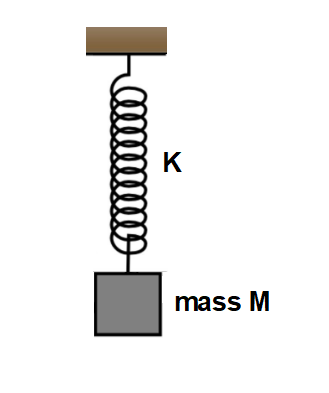 A light vertical spring has an original unstretched length Lo. A block of mass M is carefully attached to its
lower end, and the block comes to rest when the new length of the spring is L. Finally, the block is pulled down
the distance X, and then it is released, causing the block to oscillate up and down from the equilibrium line.
A light vertical spring has an original unstretched length Lo. A block of mass M is carefully attached to its
lower end, and the block comes to rest when the new length of the spring is L. Finally, the block is pulled down
the distance X, and then it is released, causing the block to oscillate up and down from the equilibrium line.
The application will ask to enter the following data:
the mass M of the block.
the initial length of the spring Lo.
the new length of the spring L.
the additional length x the spring is stretched.
The value of gravity g.
The following quantities will be calculated:
the force constant K of the spring.
the frequency f.
the period T.
the maximum speed of the block V.
the maximum acceleration a of the block.
For convenience, the student will assume that the block has zero Potential Energy PE when it is located at the
lowest point of each oscillation. Starting at the lowest point, for every centimeter the block moves, the
following values will be calculated:
Potential Energy of the block
Kinetic Energy of the block
Potential Energy stored in the spring
Velocity of the block
Acceleration of the block
It is recommended that teachers give a different set of values to each student. To practice graphing, the
students will do the graph Displacement ( -x to +x ) vs. PE (block), KE (block), PE (spring), and TE.
The Vertical Spring Project 1: The data for one student is entered on the screen in a few seconds, and the
answer key is printed on the screen and also sent to a textfile right away. It includes a tutorial that explains
step by step the solution of this problem.
Link to The Vertical Spring Project 1 in TpT
Cost: $12.00
The Vertical Spring Project 2: The data for one student is entered on the screen in a few seconds, and the
answer key is printed on the screen right away. It includes a tutorial that explains step by step the solution
of this problem.
Link to The Vertical Spring Project 2 in TpT
Cost: $12.00
The
Pendulum Class Project
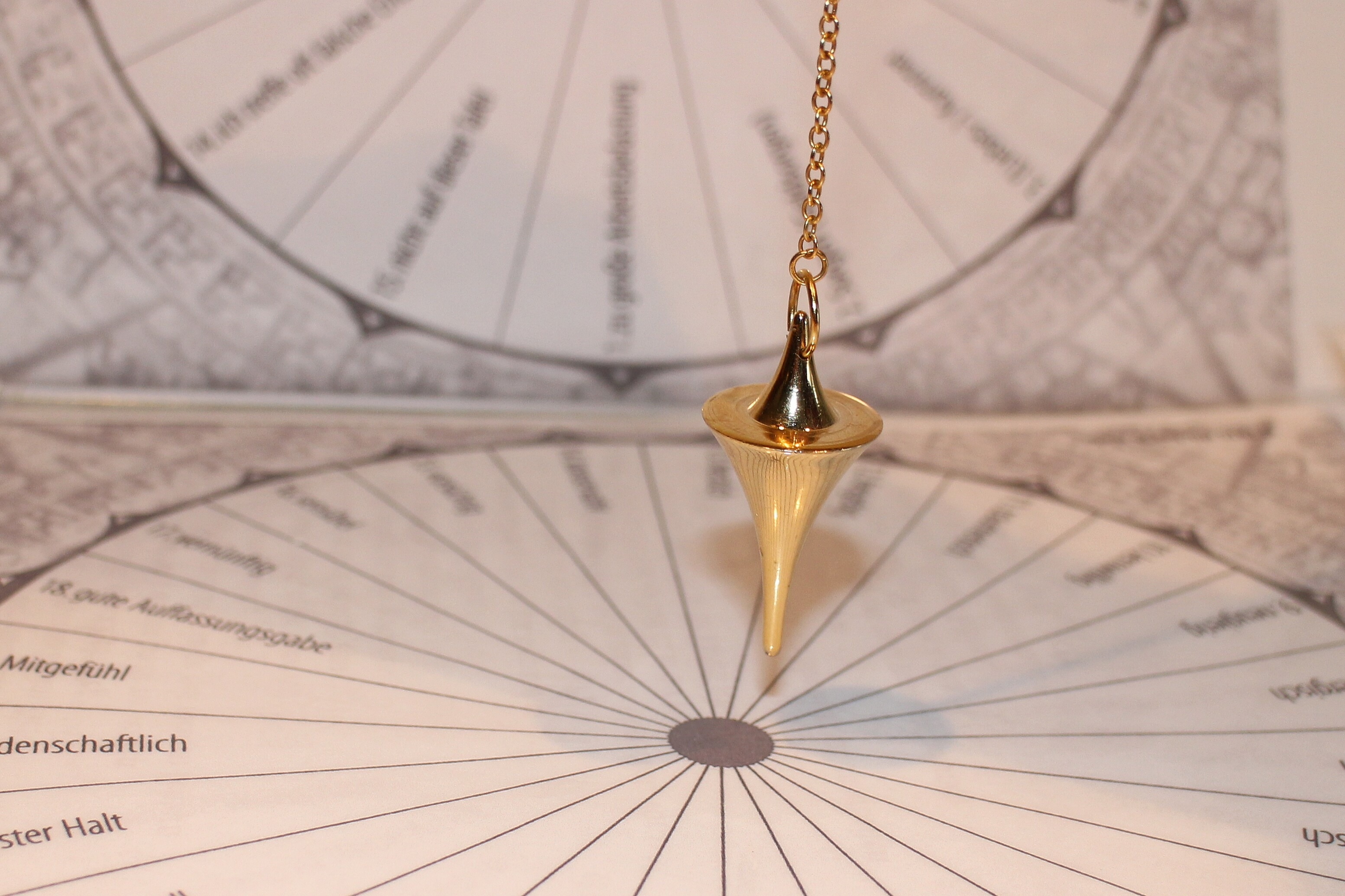
The bob of a pendulum is released and it keeps keeps swinging back and forth.
The application will ask to enter the following values:
the mass m of the bob.
the length L of the string.
the angle θ with the vertical the pendulum is released.
The value of gravity g.
The computer will find:
Period and Frequency
The Maximum Velocity
Maximum Kinetic Energy
For every degree the pendulum moves, the following values are calculated:
Velocity
Kinetic Energy KE
Potential Energy PE
Total Energy TE
Centrifugal Force
Tension in the string
Net Force
Linear Acceleration
Angular Acceleration
All the results will be printed on the screen.
The Pendulum Project: The data for one student is entered on the screen in a few seconds, and the answer key is
printed on the screen right away. It includes a tutorial that explains step by step the solution of this
problem.
Link to The Pendulum Project in TpT
Cost: $12.00
The Block on the Sphere Class Project
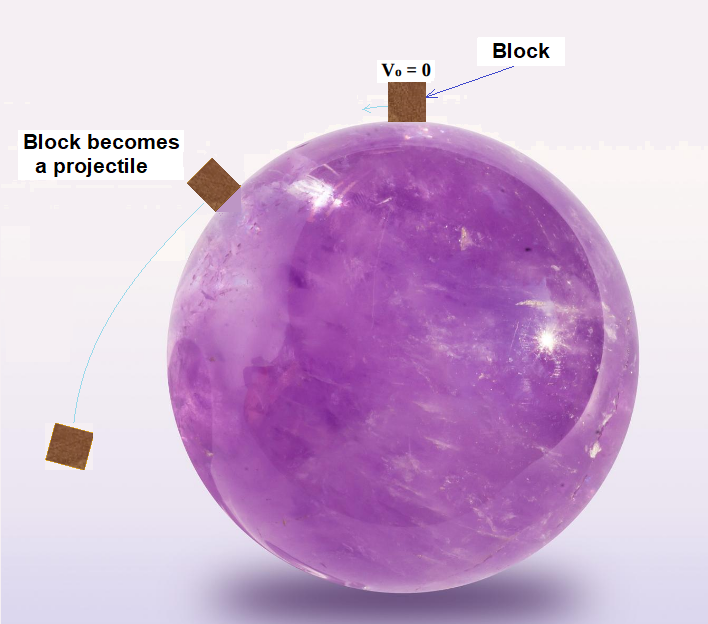
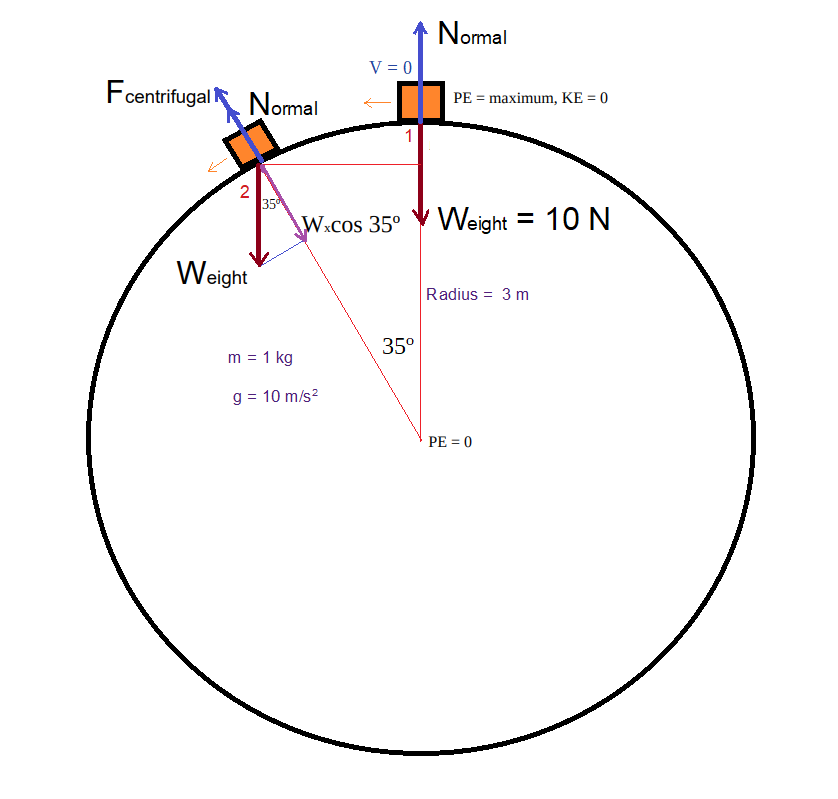
A small block is placed on top of a large sphere. The block is then touched very softly, causing it to slide,
starting from rest, on the frictionless surface of the sphere. Eventually, the block loses contact with the
surface of the sphere and becomes a projectile.
The application will ask to enter the following data:
the mass m of the block.
the radius R of the sphere.
The value of gravity g.
From the moment the block is released on top of the sphere, to the moment the block becomes a projectile after
traveling an arc in degrees that needs to be estimated, for every 5-degree segment the block slides, the
computer will calculate the following quantities:
the Potential Energy PE (PE of the block is zero at the center of the sphere).
the Kinetic Energy KE of the block.
the Total Energy TE.
the Velocity V of the block.
the linear acceleration a.
the Centrifugal Force F.
the Normal Force N.
The Block on the Sphere Project 1: The data for one student is entered on the screen in a few seconds, and the
answer key is printed on the screen right away. It includes a tutorial that explains step by step the solution
of this problem.
Link to The Block on the Sphere Project 1 in TpT
Cost: $12.00
The Block on the Sphere Project 2: The data for one student is entered on the screen in a few seconds, and the
answer key is printed on the screen and also sent to a text file right away. It includes a tutorial that
explains step by step the solution of this problem.
Link to The Block on the Sphere Project 2 in TpT
Cost: $12.00
Gravitation
Class Project

The Gravitation projects outlined below produce a substantial amount of astronomical data concerning the planets Earth, Mars, Jupiter, and Saturn. Each project comprises a detailed 17-page tutorial on Gravitation, which thoroughly explains each concept, along with 12 numerical exercises. The subsequent information regarding the planets is accessible and utilized by the respective application:
Radius of Orbit
Sidereal Period of Revolution
Radius of the body
Period of Rotation around its own axis
Mass
Initially, each application calculates the following:
Strength of gravity on the surface
Average density
Altitude of an isosynchronous satellite
Average orbital velocity
Period of a satellite at an altitude of 1,000 km
Escape velocity
The main feature of each application is that for any altitude that is entered (from 0 km to 1 million km), the
computer will estimate the following values:
Strength of Gravity
Orbital Velocity
Orbital Period
Centripetal acceleration
All the results are printed on the screen
Gravitation Project 1 - Planet Earth
Link to The Gravitation Project 1 - Planet Earth in TpT
Cost: $12.00
Gravitation Project 2 - Planet Mars
Link to The Gravitation Project 2 - Planet Mars in TpT
Cost: $12.00
Gravitation Project 3 - Planet Jupiter
Link to The Gravitation Project 3 - Planet Jupiter in TpT
Cost: $12.00
Gravitation Project 4 - Planet Saturn
Link to The Gravitation Project 4 - Planet Saturn in TpT
Cost: $12.00
Home Page
Physics Worksheets
Chemistry
Biology
Physical Science
Links to Ceres Science in TpT
AP Physics 1 Projects
Earth & Space Science
Physics Test Generators
Physics Video Exams
Anatomy
Balsa Wood Bridges
Electric Motors
Computer Science Worksheets
Health Science
Zoology
View & Play Activities
Free Materials
Boards in Pinterest
BASIC Language
Physics Applications
Chemistry Applications
Physics Lessons
All Science Products
To Facebook
Physics & Chemistry Labs

